Over the past year, enthusiasm for AI has remained strong while pressure on application companies has increased. The more capable foundation models become, the easier it is for platform providers to absorb generic products. Writing, translation, summarization, coding assistance and image generation are widely demanded and can be built directly into model products. A thin layer consisting of an API, a chat box and a polished interface is therefore a shrinking moat.
a16z’s Big Ideas 2026 and related commentary repeatedly make the same point: the first half of AI was a contest between models; the next half will look more like a contest between industries.
This is particularly relevant to mineral exploration. The real value of AI is not a clever-sounding answer. It is the ability to organize complex, fragmented and uncertain geoscientific information into professional judgments that are explainable, traceable and testable. GAIA focuses on this movement from general intelligence to industry intelligence: in the field, the central question is not whose model has more parameters, but who understands mineral systems, data quality, expert knowledge and engineering validation.
The boundary of general-purpose AI
General applications are easy to see and quick to launch, but their very generality makes them close to the core capability boundary of OpenAI, Anthropic, Google and other providers that control models, compute, distribution and user entry points. A platform update can turn an independent feature into a default component of a broader product.
General AI remains useful, but “a better chat box,” “a smoother copilot” or “a more attractive interface” rarely creates durable application-layer differentiation. As capability becomes widely available, generic tasks are more easily platformized, componentized and offered at very low cost. The strategic question is which problems cannot be fully absorbed by one foundation-model upgrade.
The process moat of vertical AI
The answer often lies in vertical sectors: insurance claims, medical imaging, financial audit, construction, manufacturing operations and mineral exploration. These environments contain industry rules, legacy systems, unstructured records, tacit judgment and compliance boundaries. They are harder to penetrate with a standard product, and that complexity is exactly where value can accumulate.
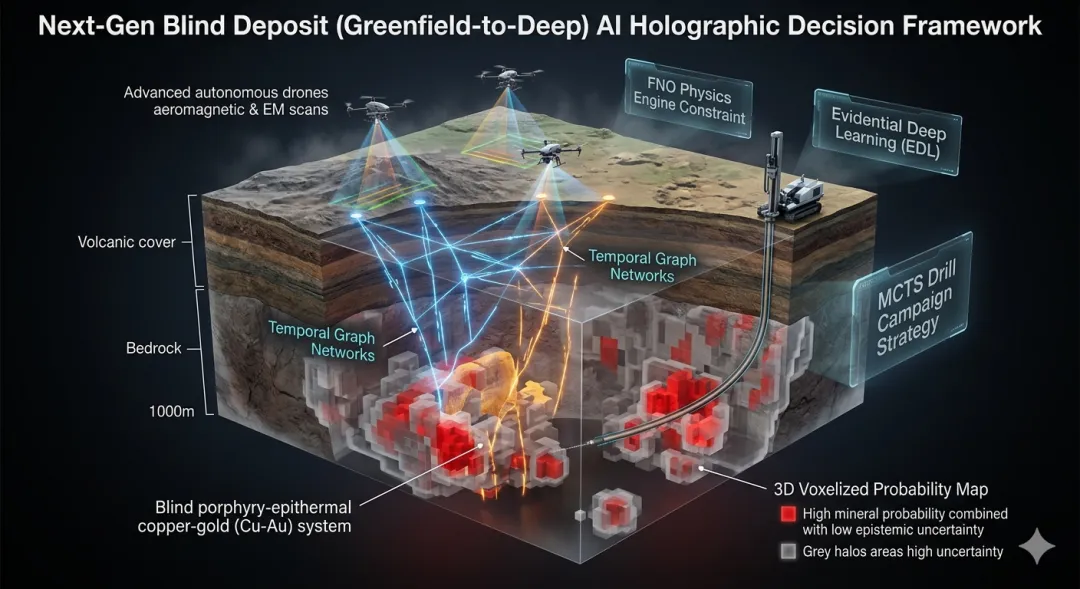
A general model can generate an answer but does not inherently understand how an industry works or assume professional responsibility. In exploration, maps, geophysics, geochemistry, remote sensing, spectral information, drilling, historical reports and expert interpretations come from different eras, coordinate systems and quality regimes. An anomaly cannot be judged solely by a probability score or heat map; it must be related to metallogenic setting, structural control, alteration association, sample reliability and validation cost.
The difficult task is not to make AI say “this place has potential.” It is to clarify the evidence: what supports a target, what conflicts, what is missing, and which field or engineering action will test the hypothesis. Vertical AI enters the workflow in which professional judgment is created, reviewed and verified.
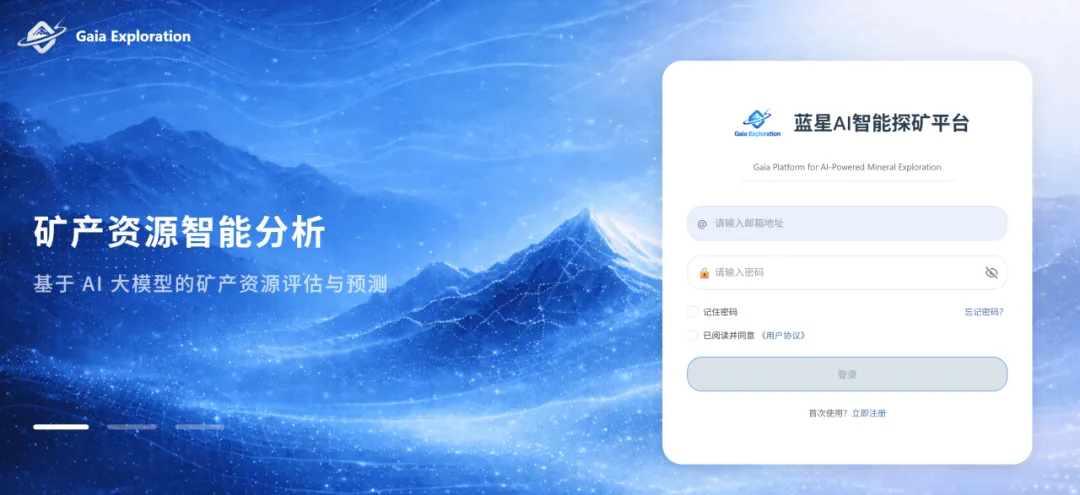
The core moats of industry intelligence
a16z’s analysis points to several mutually reinforcing sources of defensibility.
Tacit industry knowledge. Critical knowledge often lives in practitioner judgment, historical reports, workflow details and edge cases rather than on the open internet. The same geochemical anomaly may mean very different things in different metallogenic belts, deposit types and weathering regimes. A model that lacks that context reduces geology to surface correlation.Multi-model and multi-tool orchestration. Complex reasoning, image interpretation, spatial analysis, text extraction, cleaning and retrieval may require different models and tools. The value lies in reliable task orchestration, not in sending every problem to one model.Task-based economics. Foundation providers sell general intelligence; vertical systems address business tasks. AI may move software economics away from seat-based pricing and toward labour substitution or measurable outcomes, but only when it is truly embedded in the workflow.Governance and responsibility. Vertical work involves compliance, audit, data rights and professional accountability. In mining, a model output cannot equal discovery, resources or commercial success. It is a hypothesis that requires expert review, field investigation and drilling feedback.
GAIA’s standard of credibility is therefore not “what did the model say?” but “how was the judgment formed, what supports it, where is uncertainty, and how will the next action test it?”
A multi-role collaboration model
Vertical AI is also moving from a single-user mode to multi-party collaboration. Earlier AI acted as a personal assistant. Future systems will participate in networks across roles, systems and permissions, exchanging context, marking risks and preserving human approvals.
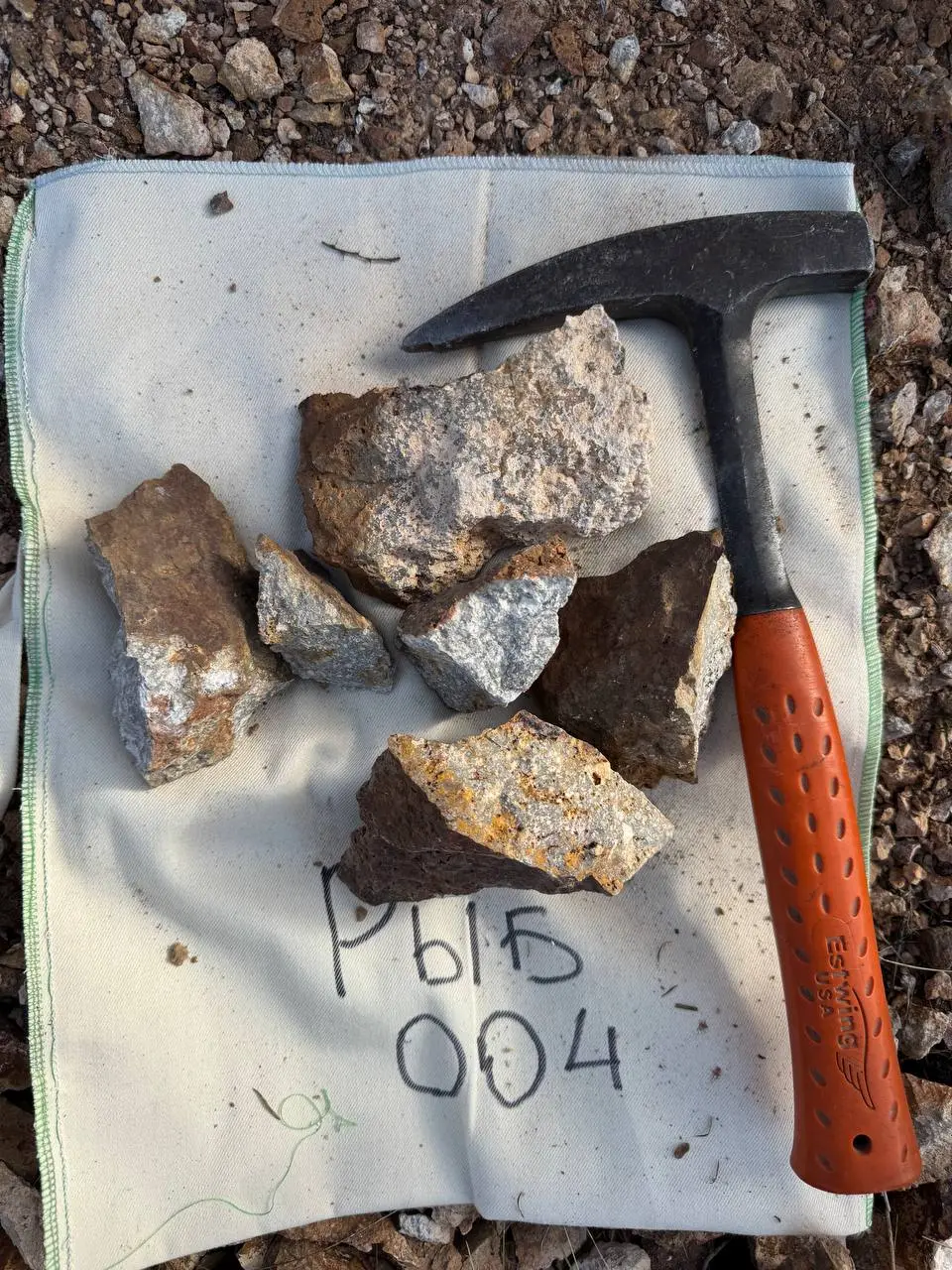
Exploration is already multidisciplinary. Regional geology, geophysics, geochemistry, remote sensing, drilling, sampling, resource evaluation and investment decisions form one continuous chain. Moving a target from anomaly to validation requires different roles to align on the same evidence.
Vertical AI can therefore do more than raise one specialist’s productivity. It can help a team share a traceable hypothesis: why a target ranks higher, which evidence matters most, which uncertainty should be addressed first and how new results update the model. GAIA’s position is that AI should amplify expert judgment, not replace professional debate with a black-box score.
Agent infrastructure is part of the constraint
Deeper application also forces changes in infrastructure. Enterprise systems were largely designed for one human action followed by one response. An agent can decompose a goal into a rapid stream of subtasks, database queries and API calls. To an old system, the traffic can resemble a denial-of-service event.
Production bottlenecks therefore include routing, state management, concurrency, permissions and tool reliability as well as compute and storage. The geoscience version is particularly demanding: large spatial datasets combine tables, maps, sections, imagery, reports and drillhole records. A working system must manage coordinate consistency, terminology, sample-hole relationships, versions and write-back.
These tasks are not glamorous, but they separate a demonstration from a professional production environment. Mining AI is not a general model connected to a folder of reports. It needs infrastructure for professional data, workflows and responsibility, allowing information organization, model reasoning, expert review and field verification to close the loop.
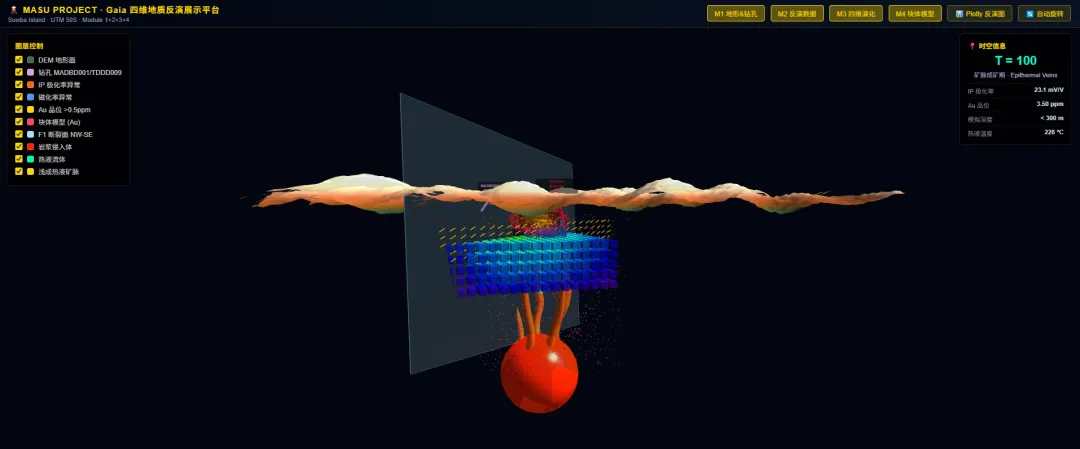
Evidence-chain-driven mining AI
A robust path can be summarized in four steps:
- Define the professional question. For example, which structural-lithological-alteration associations within a belt deserve priority testing?
- Integrate the evidence. Compare regional geology, geophysics, geochemistry, remote sensing, drilling and historical reporting in one frame.
- Explain the judgment. State why an anomaly matters, which evidence supports or conflicts with it, and where data are inadequate.
- Design the test. Use mapping, sampling, trenching, denser geophysics or drilling to challenge the hypothesis.
AI organizes complex information, quantifies uncertainty, compares targets and exposes missing data. It can change the sequence of work and collaboration, but it cannot change geological law. A prospectivity heat map is therefore not the conclusion. Every target rank must return to its geological context, supporting and conflicting evidence, data gaps and executable next action.
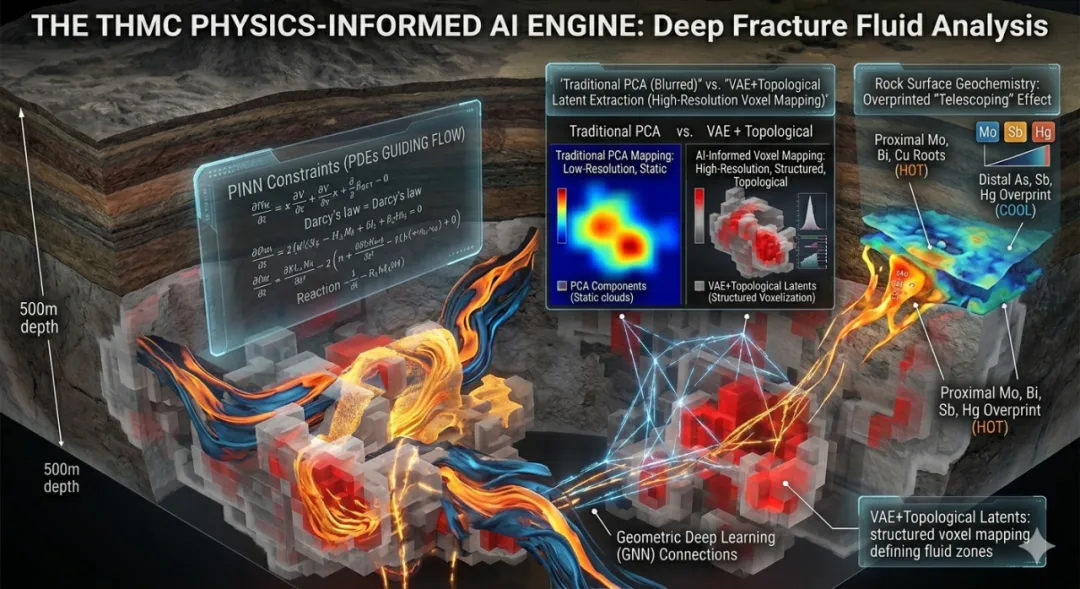
This is the distinction between vertical and general AI: not better conversation, but deeper understanding of how an industry forms judgments, carries responsibility and reaches verification.
Conclusion: value returns to field verification
The broad lesson is clear. Generic tasks will become increasingly crowded, while deeper opportunity moves into real industry environments, complex processes and professional accountability. This is a difficult route because it requires dirty-data work, respect for governance and continuous real-world testing. That difficulty creates the possibility of durable value.
In mineral exploration, AI should not announce what has been discovered. It should help teams identify clues earlier, compare evidence more clearly, manage uncertainty more cautiously and use scarce validation resources in better-supported directions. GAIA will continue connecting AI, geological mechanisms and mining expertise so that mining AI moves from concept excitement toward professional trust: fieldwork is not replaced by a model, and verification is not replaced by a prediction.