Ethiopia has a long history of gold mining, with placer and primary gold widely distributed across Precambrian basement terranes in the west, south and north. For modern exploration, however, a surface gold anomaly is not the same as a deposit of meaningful scale. Thick laterite and saprolite can weaken bedrock signals, while multiple phases of deformation can cut and rework earlier mineralization, so outcrops, quartz veins and soil anomalies do not map simply onto deeper ore bodies.
To address this problem, Gaia Exploration systematically organized the available material for Ethiopia and examined gold distribution and depth potential from a mineral-system perspective rather than as a collection of isolated anomalies. The source material links Ethiopian gold mineralization closely to Neoproterozoic plate accretion, the Pan-African orogeny, major shear-zone activity and later fluid overprinting.
PART 01
The structural framework: Ethiopia’s gold pattern within the East African Orogen
Ethiopia’s Precambrian basement forms an important part of the East African Orogen and records the breakup of Rodinia, the opening and closure of the Mozambique Ocean, and the collision and assembly of East and West Gondwana between roughly 850 and 550 million years ago.
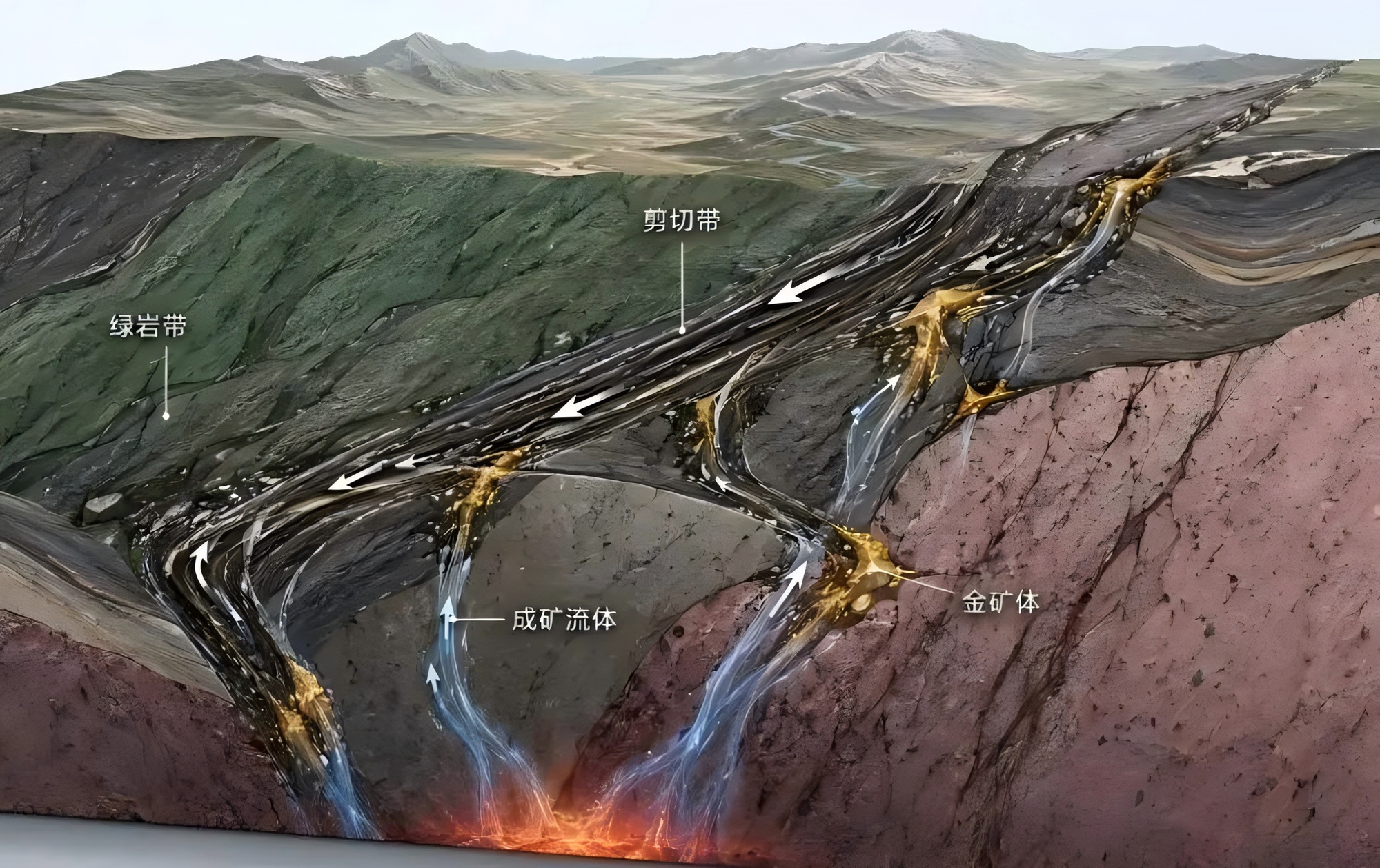
Geographically, the country lies between the lower-grade Arabian–Nubian Shield and the higher-grade Mozambique Belt. The western shield is dominated by NE–SW-trending metavolcanic–sedimentary schist belts and ophiolitic remnants, while the south contains greenstone belts including Adola–Kenticha, Hagere Mariam, Arero and Moyale. Repeated accretion during collision and oblique compression produced multiple generations of brittle–ductile strike-slip shear structures.
These major shear zones are both regional tectonic boundaries and important pathways for deep mineralizing fluids. As fluids rise into shallower crustal levels, they can focus in bends, splays, stepovers and lithological contacts. This helps explain why many primary gold deposits in Ethiopia are not randomly distributed, but cluster along greenstone belts and major shear systems.
PART 02
Three mineral systems define the main gold-resource framework
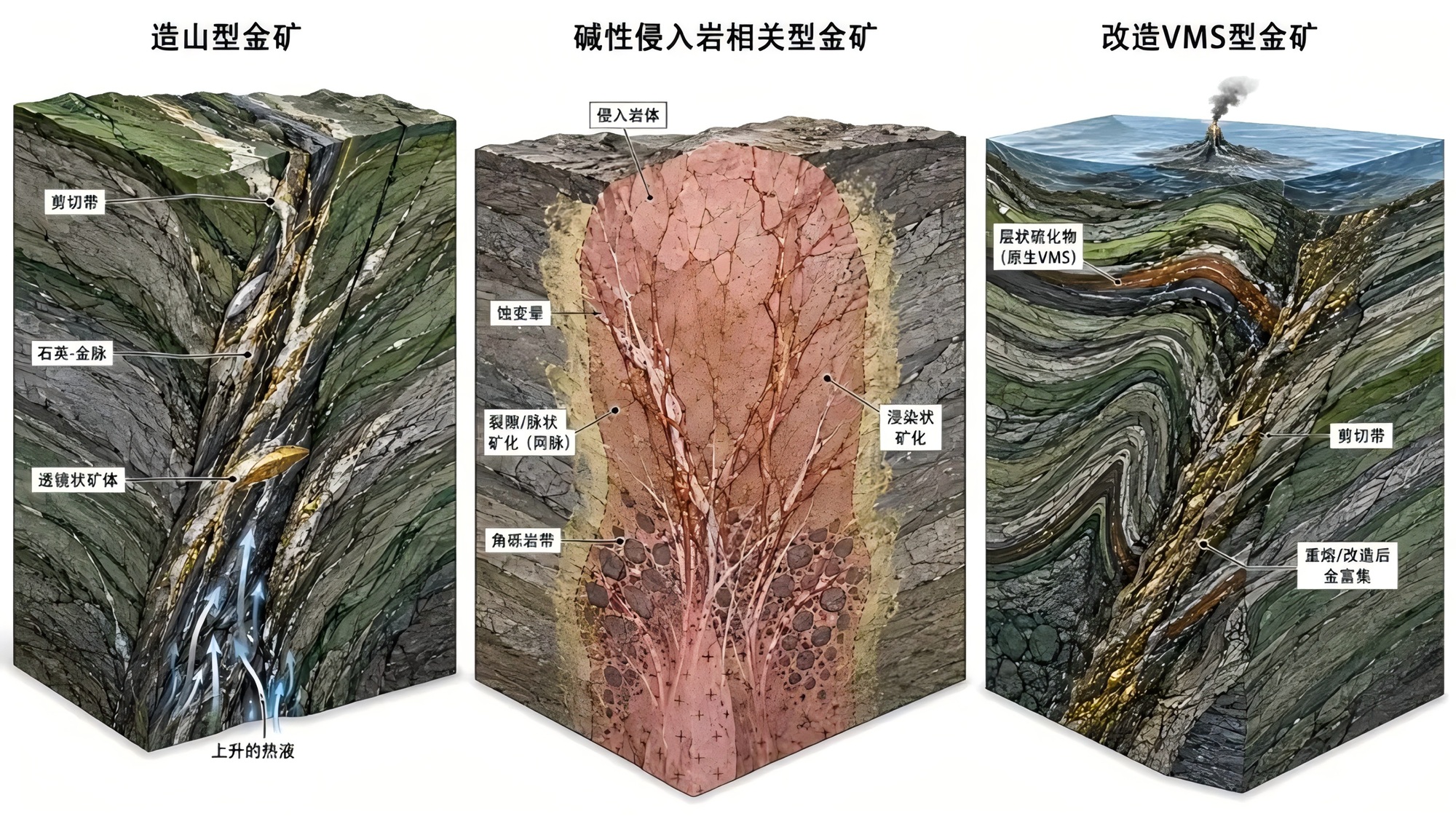
Based on genetic mechanism, host-rock lithology, structural setting and alteration style, Ethiopia’s primary gold deposits can be grouped broadly into orogenic gold, alkaline intrusion-related gold, and VMS-related gold systems that were subsequently modified by deformation and metamorphism.
Orogenic gold is the most widespread and economically significant of the three. Mineralization generally post-dates the main regional metamorphic event and is controlled by major strike-slip shear zones developed during the roughly 550–500 Ma orogenic stage. Ore bodies commonly occur in low-greenschist- to lower-amphibolite-facies metavolcanic–sedimentary rocks as veins, stockworks, tabular bodies or lenses. Lega Dembi, Sakaro, Kurmuk, Menge and Dul Mountain are cited in the source material as examples of this system.
The second type, represented by Tulu Kapi, is alkaline intrusion-related gold closely associated with a mildly alkaline syenite emplaced at about 738 Ma. Mineralization occurs mainly in albitized zones, fracture networks and brecciated domains within the intrusion, forming stacked, shallow-dipping, stockwork and disseminated bodies. The source material cites combined indicated and inferred resources of about 24.9 Mt at an average gold grade of about 2.34 g/t, and reserves of about 16.9 Mt at about 1.82 g/t.
The third system originally formed in back-arc basin or island-arc rift settings, where seafloor hydrothermal activity produced massive or banded sulfide mineralization. Later Pan-African deformation folded, sheared and metamorphically overprinted these horizons, allowing gold to be locally reconcentrated along shear zones or structural unconformities.
PART 03
Lega Dembi: the combined control of shear zones and carbonaceous host rocks
Lega Dembi is one of the best-known orogenic gold deposits in the Adola greenstone belt of southern Ethiopia. The ore system is controlled by the Lega Dembi–Aflata ductile strike-slip shear zone and occurs mainly as steeply dipping, near north–south tabular and lenticular vein arrays. The source material notes that historical evaluations cited reserves of about 260 tonnes, at average grades of about 3–6 g/t.
The deposit records a multistage structural history. The main mineralizing event is linked to oblique ductile strike-slip deformation during the middle to late Pan-African orogeny. Strong rheological contrasts between metamorphosed conglomeratic rocks and metamorphosed felsic clastic rocks promoted local dilation and hydraulic fracturing during shearing, creating space for fluid ingress and quartz-vein development. Later faulting displaced and reworked earlier ore, making continuity more complex.
Mineralizing fluids rose along the shear zone and underwent phase separation in local pressure-release sites such as bends and stepovers. Where the fluids passed through black graphitic–carbonaceous schists rich in reduced organic matter, oxygen fugacity decreased and the stability of gold–sulfur complexes broke down, promoting rapid deposition of gold together with lead and zinc and producing a characteristic gold–galena–sphalerite–quartz vein association.
Lega Dembi shows that orogenic gold formation depends on more than simply the presence of a fault. Lithological contrast, local dilational space and water–rock reaction within the shear system are also critical.
PART 04
Tulu Kapi: fracture networks and desulfidation within syenite
Tulu Kapi differs from a typical shear-zone-hosted gold deposit. Mineralization is developed mainly inside a Neoproterozoic mildly alkaline syenite and is influenced by the rheological contrast between the syenite and the surrounding low-grade metavolcanic–sedimentary schists.
Under regional compression, softer phyllites and mica schists deform plastically, whereas the more competent syenite concentrates brittle failure, generating subhorizontal extensional fractures, joint networks and fine breccia zones. Early albitization further increased rock strength and brittleness, helping prepare the intrusion for later fracture development and fluid injection.
During mineralization, fluids entered these fractures and reacted with iron-rich minerals in the syenite, including biotite, amphibole and magnetite, through iron–sulfur replacement that formed disseminated pyrite. As sulfur in the fluid was consumed, gold previously transported as gold–sulfur complexes became unstable and precipitated as native gold. The resulting ore is represented by shallow-dipping stacked mineralized bodies associated with quartz, albite, sericite and pyrite.
This model indicates that the key geological signal at Tulu Kapi is not simply the syenite body itself, but the combined development of internal fracture networks, albitization and pyrite mineralization.
PART 05
Pressure–temperature records preserved by mid- to deep-crustal fluids
Fluid-inclusion and stable-isotope studies provide important constraints on the mineralizing environment of Ethiopian gold systems. Although host rocks and structural styles vary among districts, many orogenic deposits share metamorphic-hydrothermal characteristics involving moderate temperature, moderate pressure and relatively low salinity.
The studies summarized in the source material indicate that ore fluids were generated and transported mainly in mid- to deep-crustal environments, commonly as H₂O–CO₂-dominated fluids containing some dissolved salts. As these fluids rose through deep faults and shear zones, local dilation, pressure reduction and temperature change modified their physicochemical conditions and created opportunities for gold transport and precipitation.
Oxygen- and hydrogen-isotope signatures overall point to a metamorphic-dehydration source, in which hydrous volcanic rocks, clastic rocks and schists released fluids during regional metamorphism. Some intrusion-related deposits also show evidence for mixing between magmatic fluids and metamorphic waters. Decompression, phase separation and water–rock reaction during ascent ultimately promoted gold precipitation in favourable structural sites.
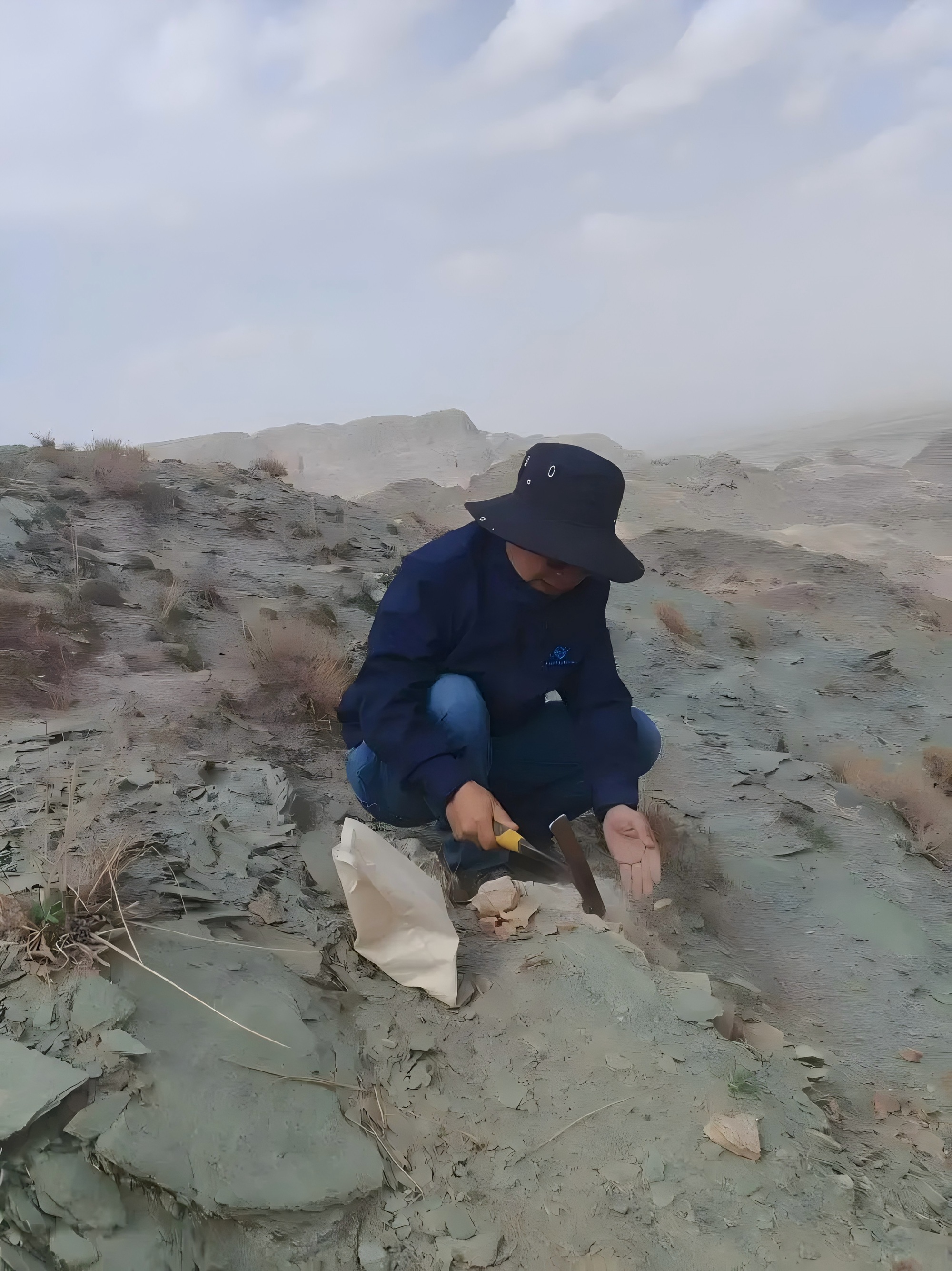
These observations also imply that the roots of many Ethiopian gold systems lie in the middle to deeper crust. Quartz veins, alteration zones and gold anomalies visible today at surface are only partial records of those deeper mineralizing processes.
PART 06
Multi-source geological responses beneath laterite cover
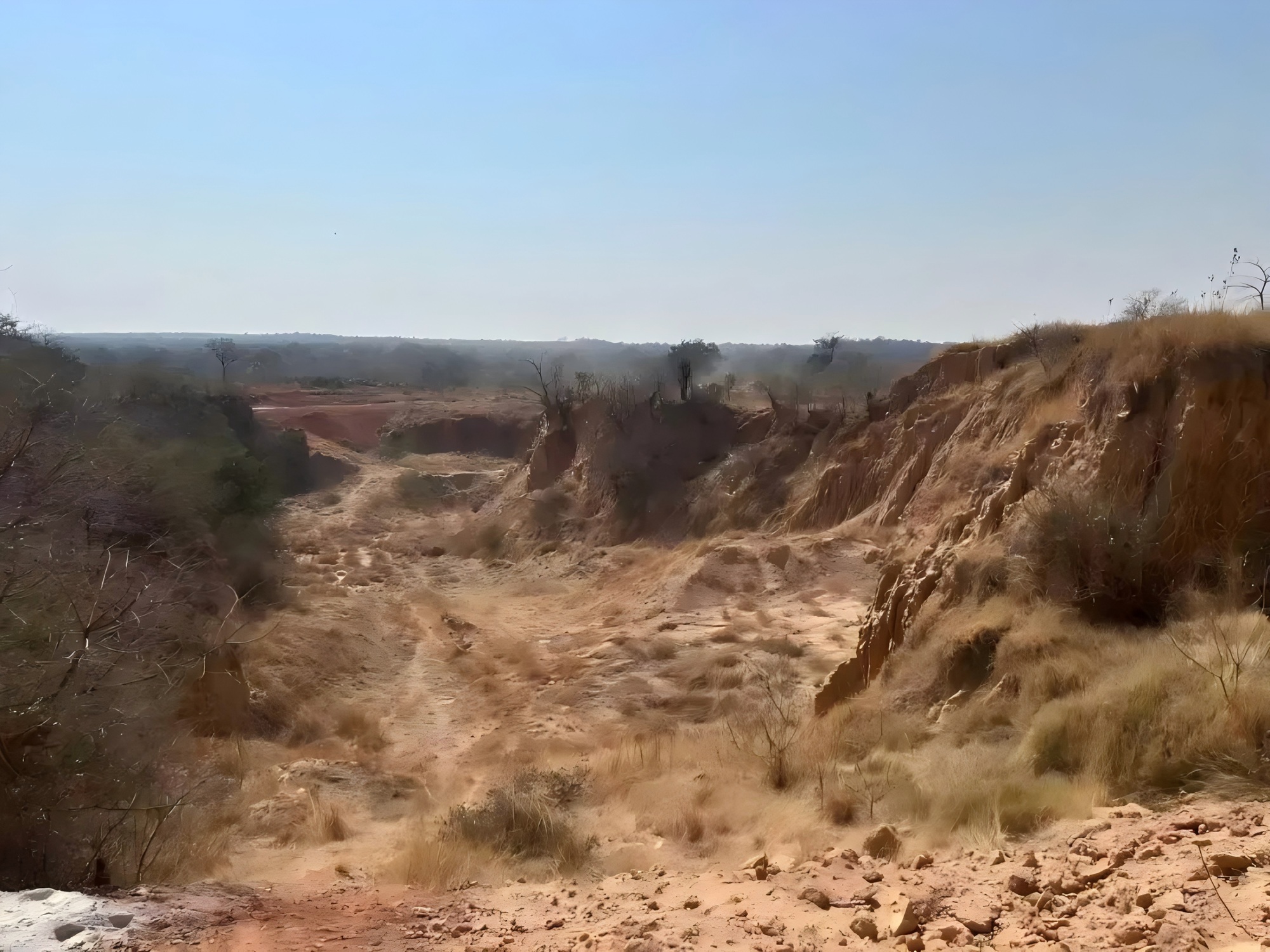
Many Ethiopian gold districts contain thick saprolite and laterite weathering profiles, leaving limited bedrock exposure. During prolonged weathering, primary mineralization signals may be weakened, displaced or locally re-enriched. Surface quartz veins or a single gold anomaly therefore may not accurately locate or define the continuity of deeper mineralization, making an integrated interpretation of structure, alteration, geophysics and geochemistry necessary.
Gold-bearing hydrothermal activity may destroy or transform magnetite in the protolith and may also be accompanied by enrichment of sulfides such as pyrite and pyrrhotite, producing magnetic and induced-polarization responses that differ from the surrounding rocks. Silicification, carbonatization, sericitization, albitization and pyritization are also developed to varying degrees in representative districts including Lega Dembi, Tulu Kapi and Menge.
These geological, geochemical and geophysical responses can help identify areas of stronger hydrothermal activity and favourable structure, but no single anomaly is equivalent to an ore body. Scale, continuity and depth extent still require constraints from geological mapping, geophysics, geochemistry, trenching and drilling.
PART 07
From regional anomalies to evidence for deeper mineralization
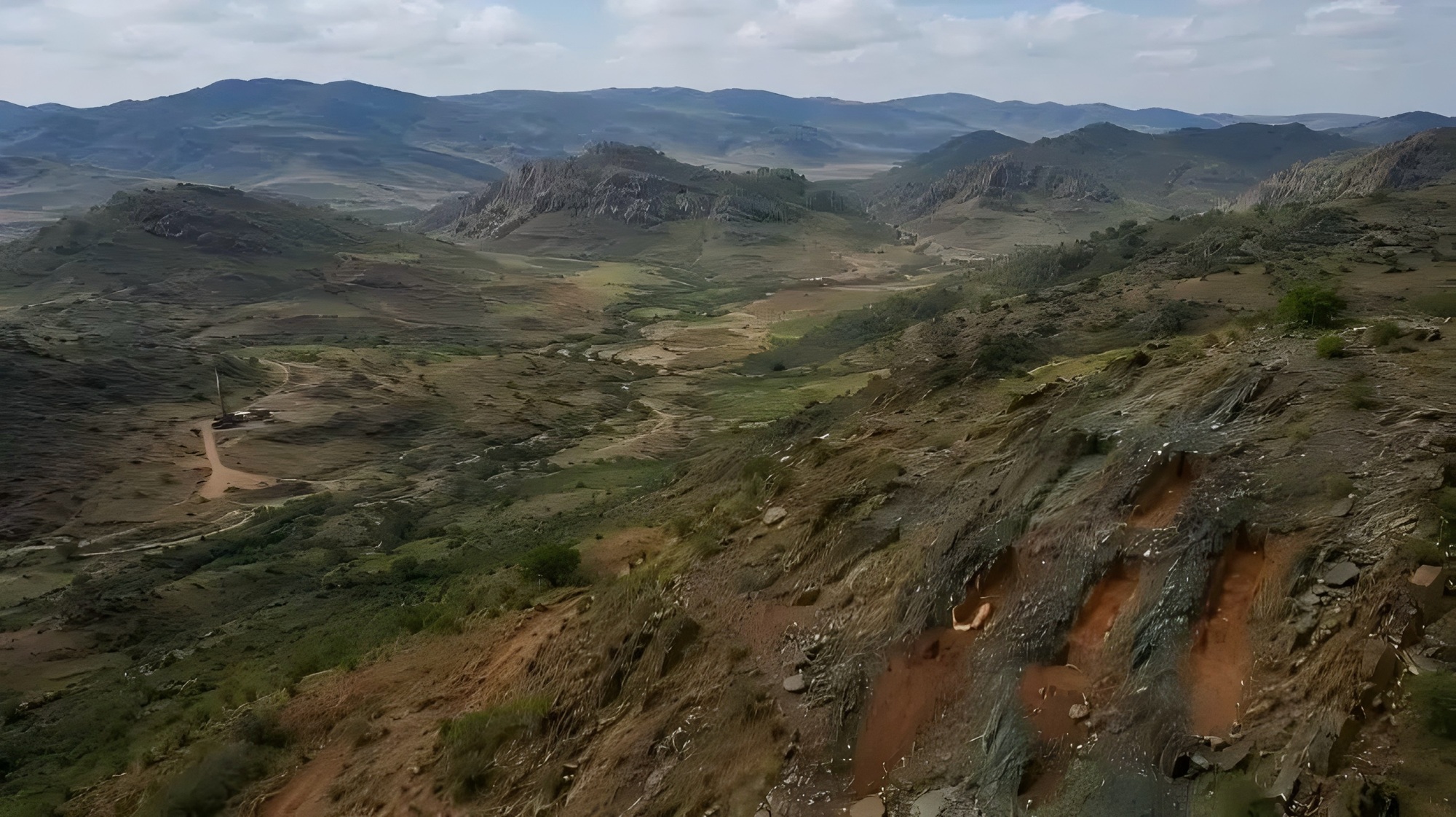
Parts of the western Ethiopian greenstone belts lie within important primary-gold metallogenic domains. Regional geochemical surveys, trenching and drilling indicate that some anomalous zones contain mineralized and altered structures with meaningful strike extent.
Engineering work has locally intersected continuous mineralized intervals, and results from different locations correspond with one another in ways that suggest possible continuation at depth. Soil-gold geochemical anomalies also occur along nearby structural belts, although the overall level of engineering control remains limited.
These results indicate that the western greenstone belts still have room for deeper evaluation. Whether a regional anomaly can be upgraded into a mineralized body of meaningful scale depends on whether structure, alteration, geochemical anomalies and subsequent engineering intersections can form a continuous and mutually supporting evidence chain.
PART 08
Gaia AI connects dispersed geological evidence
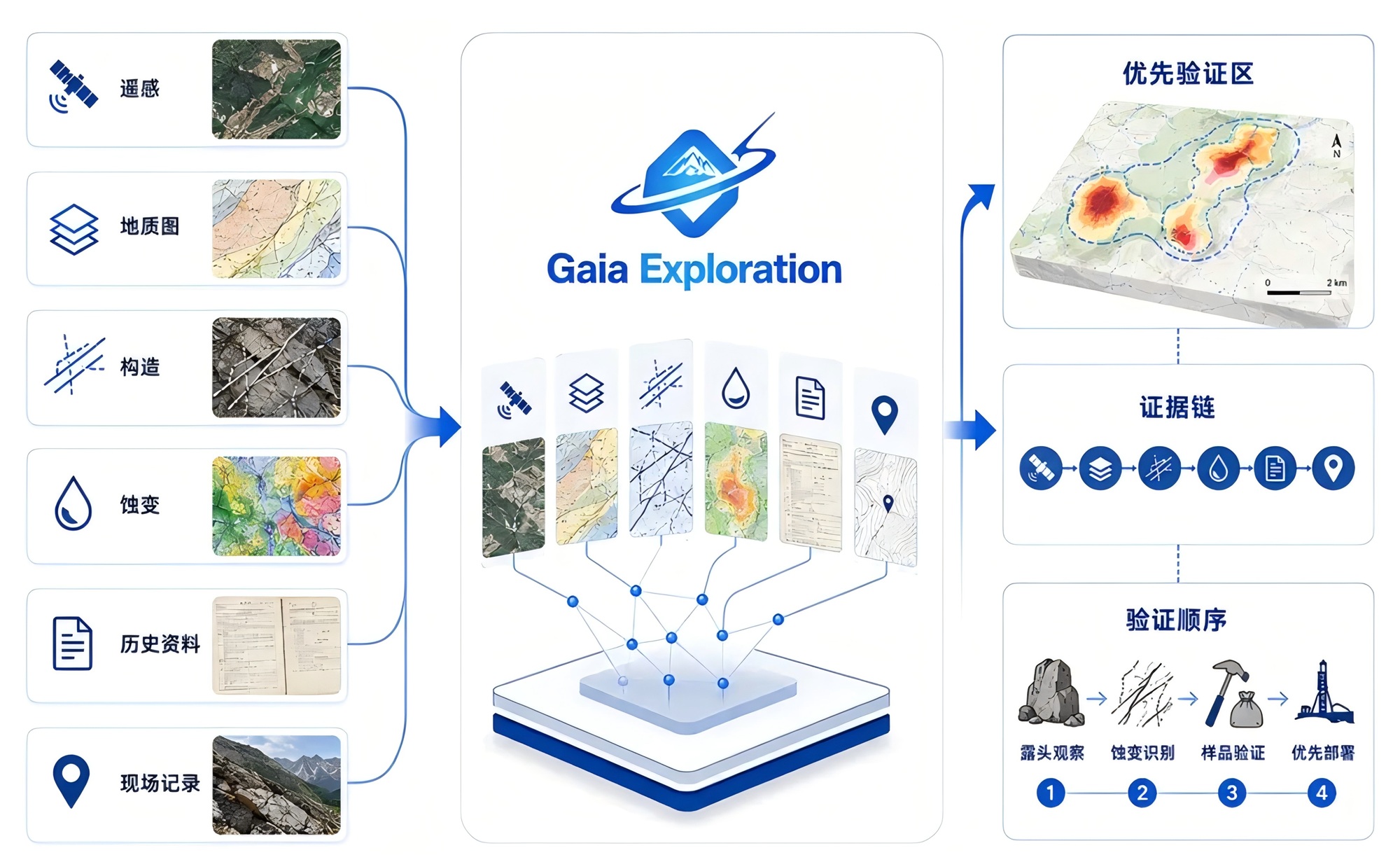
In this study, Gaia Exploration first used geological AI agents to organize regional geology, deposit studies, geophysical and geochemical data, trench information and drill records. Structural trends, host-rock types, alteration assemblages, mineralization styles, grades and thicknesses scattered across separate reports were converted into information that could be compared and interpreted consistently.
Gaia then treated the different deposit types according to their genetic distinctions, interpreting orogenic, alkaline intrusion-related and overprinted VMS-related gold separately rather than forcing all gold anomalies into one model. Prospectivity prediction was used to help identify areas warranting further study; 4D spatiotemporal inversion and mineralization simulation were used to understand system evolution and possible depth continuation; and drill optimization was used to support comparison of subsequent engineering options.
The purpose is not to publish a single fixed exploration formula. It is to help geological teams organize existing evidence faster, expose relationships between datasets and progressively narrow regional understanding toward the areas that most need verification. Gaia AI contributes data understanding, geological reasoning and decision support so that complex projects can be represented as clearer, traceable analytical chains.
CONCLUSION
From surface clues back to the complete mineral system
Ethiopian gold mineralization reflects the combined effects of Neoproterozoic plate evolution, major shear-zone activity, deep fluid migration and local water–rock reaction. Individual deposits differ in host rock, structural style and alteration, but each needs to be understood within the broader regional geological evolution.
Structures control fluid pathways; lithological contrasts influence fracture development and dilational space; and alteration plus water–rock reaction help determine where gold precipitates. Anomalies and mineralization revealed by geophysics, geochemistry, trenching and drilling only become useful for judging scale, continuity and depth potential when they form a mutually supporting evidence chain.
Through geological AI agents, prospectivity prediction, 4D spatiotemporal inversion and mineralization simulation, and drill optimization, Gaia Exploration converts dispersed regional geology, deposit studies and engineering data into structured geological evidence. AI does not change the rules by which gold deposits form, but it can make geological data organization, integrated interpretation and engineering verification more efficient.