In June 2026, a gold-project acquisition package was laid out before investors in Almaty, Kazakhstan. The vendor’s report presented an attractive story: the Ak I and Ak II blocks contained 16.5 million tonnes at an average grade of 0.72 g/t using a 0.2 g/t cut-off, yielding gold in the several-hundred-thousand-ounce range. With a high gold price, the project was marketed as a low-grade, bulk-tonnage, open-pittable asset with an offshore asking price of US$45 million.
GAIA Exploration reached a different view after returning to the underlying drillholes, assays, lithology, structure and metallurgical constraints. Once cut-off grade, continuity, recovery and realistic cost were placed in the same frame, the shallow gold case weakened rapidly. At the same time, sparse deep information suggested that the property might need to be reinterpreted as part of a larger porphyry-skarn copper-gold polymetallic system.
The value of the Ak case is not that one parameter was too high or too low. It shows how a seemingly mature asset is repriced when the resource, ore economics and mineral-system interpretation are all uncertain. GAIA’s technical-audit principle is to examine not only what the report concludes, but what data, geological logic and economic assumptions make that conclusion possible.
Beyond the resource table
A table of tonnes, grade, contained metal and mine life creates a strong sense of certainty. In technical due diligence, however, these figures are outputs, not the whole basis of value. The analyst must ask which samples entered the mineralized domain, why the cut-off was chosen, whether low-grade intervals were linked by interpolation, whether high-grade samples exerted excessive influence, whether recovery matches the ore mineralogy, and whether the material classified as ore can actually be mined continuously and treated economically.
Several optimistic assumptions acted together in the Ak project. A very low cut-off expanded tonnage. Ordinary kriging smoothed discontinuous mineralization. Refractory-ore recovery constraints were not fully carried into the economic model. Years of shallow gold-focused exploration may also have diverted attention from clues to the broader, deeper system.
GAIA therefore separates three categories: facts confirmed by data, interpretations that depend on the current model, and hypotheses that require the next round of work. Only after that separation does the resource table become meaningful to an investor.
The amplification effect of a 0.2 g/t cut-off
Cut-off grade determines whether a block of rock is treated as ore or waste. It should reflect metal price, metallurgical recovery, mining and processing costs, general and administrative expenses, taxes, royalties and smelter deductions. A higher gold price can improve economics, but it cannot automatically neutralize refractory ore, discontinuous geometry, rising strip ratio or capital intensity.
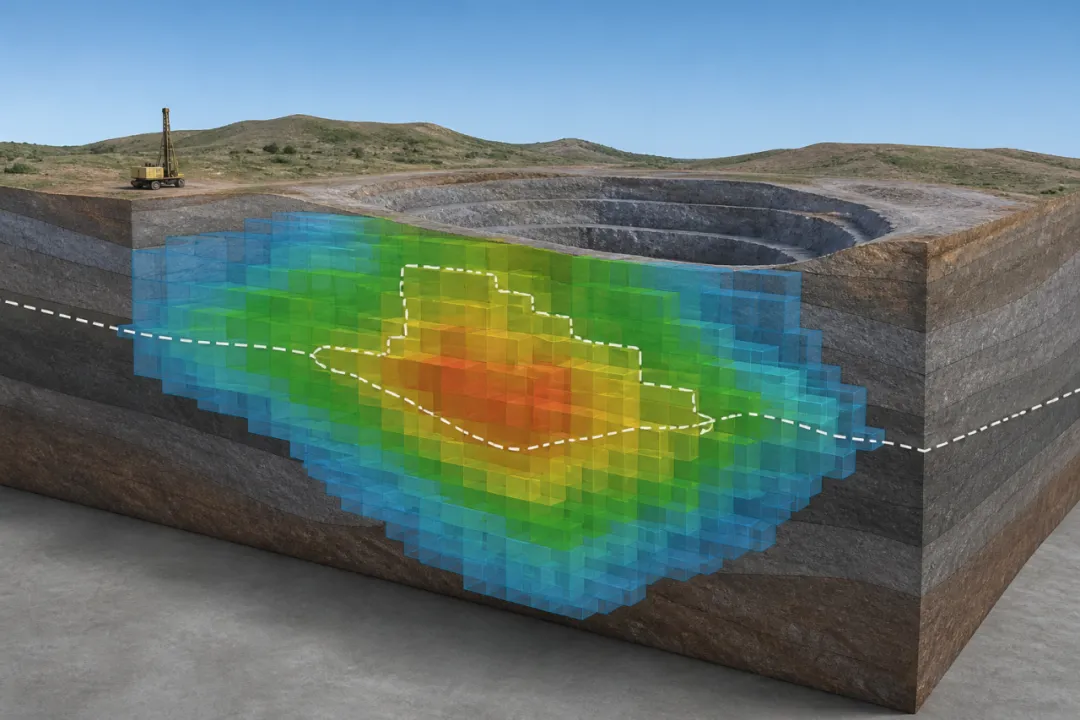
The first risk in the Ak case was the 0.2 g/t cut-off. Ordinary kriging is established and widely accepted, but in highly variable, vein-dominated or nugget-affected systems it produces a familiar smoothing effect. High-grade intervals may influence neighbouring blocks, while a large low-grade halo can be joined into a visually continuous body. If the database contains many intervals at 0.23, 0.25 or 0.31 g/t and the cut-off is itself extremely low, a considerable amount of uneconomic rock can be classified as ore. Tonnage rises quickly, but project value does not.
The audit therefore asks whether tonnes reflect real geological continuity or statistical continuity created by a low threshold and a smooth estimator. This is one role for mining AI: move below the final report into the samples, domains and estimation assumptions that generated the number.
Recovery rewrites the boundary
If cut-off determines what enters the resource, metallurgical recovery determines how much of that resource can become revenue. A 2025 process document from TOMS Institute described arsenopyrite and pyrrhotite in the primary shallow ore at Ak I and Ak II. The material is arsenic- and sulphur-rich and potentially refractory; gold may be locked in sulphide lattices, fine aggregates or complex inclusions, limiting conventional cyanide recovery.
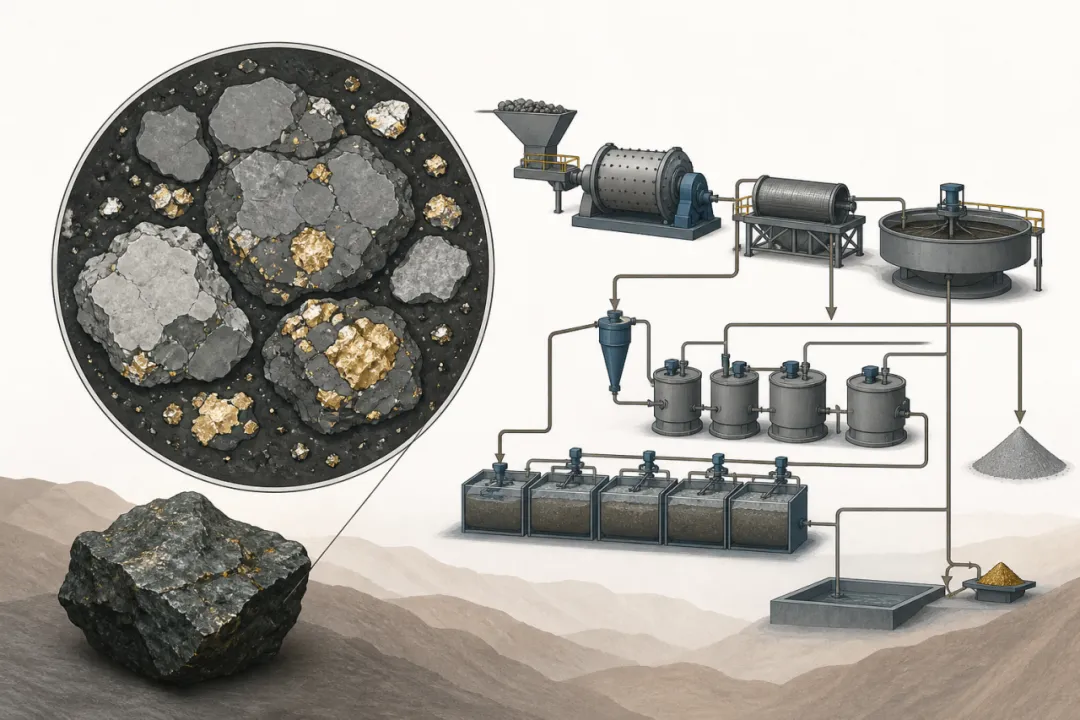
The source material indicated approximately 65% gold recovery under a conventional route. Achieving more than 80% could require pressure oxidation (POX), biological oxidation (BIOX) or ultrafine grinding, each with materially higher capital and operating costs. A high gold price is therefore not a sufficient reason to lower cut-off.
GAIA returned recovery, royalty, downstream deductions, processing cost, administration and stripping to one economic model. The available material yielded an estimated realizable net value of about US$52.75 per gram of contained gold and reconstructed operating costs of about US$68.25 per tonne. At a US$2,700/oz gold assumption, the calculated break-even cut-off was approximately 1.29 g/t. To leave room for future technical improvement, the audit used a less severe 1.0 g/t core stress-test cut-off.
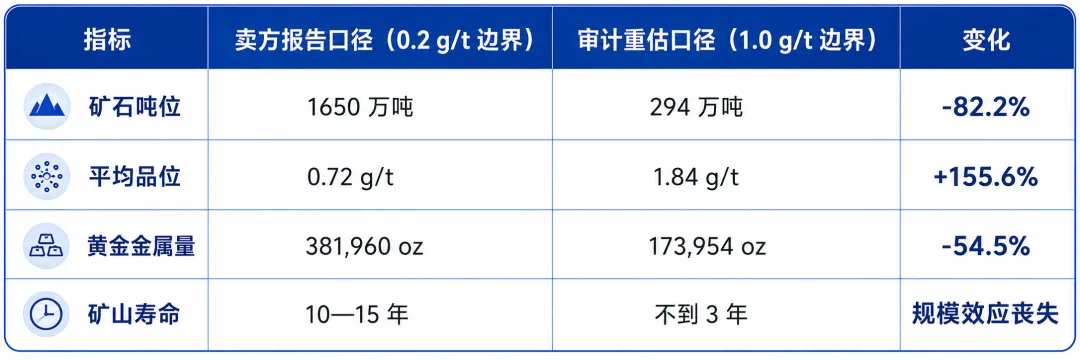
Average grade then rose from 0.72 to 1.84 g/t, which could be misread as an improvement. In fact, it meant that large volumes of low-grade material had been removed. Ore tonnage fell by 82.2%, contained gold by 54.5%, and mine life from 10–15 years to less than three. For a refractory project requiring a complex plant, the remaining issue was no longer merely grade; it was whether the reduced scale could support the processing system and capital investment. The source P50 stand-alone development case produced an NPV of negative US$68.32 million.
At this point the question was not the appropriate discount to the vendor price. The entire shallow-mine development logic required reconsideration.
The warning from CV above 2.5
The next question was spatial continuity. The coefficient of variation (CV), standard deviation divided by mean, measures dispersion. In gold systems, especially narrow veins, stockworks and nugget-affected mineralization, a high CV often indicates stronger grade volatility and less stable estimation.
GAIA’s reassessment found CV values above 2.5 in parts of the assay population. That result suggested that the apparently continuous body might instead comprise discontinuous, narrow high-grade quartz veins or vein sets surrounded by abundant low-grade or barren rock.
Simply drilling more holes does not automatically solve this problem. If domain boundaries, grade continuity and the deposit model are not retested, denser shallow drilling can create a larger and more complicated dataset without answering the essential questions: Is the ore continuous? Can it be selectively mined? Can it be treated economically?
“Drilling through” the underlying data means finding inconsistencies faster: whether cut-off fits recovery, whether the block model fits sample dispersion, and whether the exploration direction fits the complete mineral system. Credible mining AI should not end with a heat map. It should disassemble the resource model into an evidence chain that specialists can examine and challenge.
From the shallow model to the deep system
The turning point came when the shallow model lost explanatory power. At the bottoms of a small number of holes deeper than about 250 metres, diorite core reportedly contained molybdenite, bornite and traces of bismuth tellurides. These minerals were peripheral details in a shallow vein-gold resource exercise, but they carry different significance in a porphyry-skarn copper-gold polymetallic framework.
Porphyry-skarn systems are associated with intermediate to felsic intrusions, magmatic-hydrothermal activity, structural pathways and wall-rock reaction. Shallow quartz-vein gold may not represent an isolated event; it may be the upper or distal expression of a deeper magmatic-hydrothermal centre.
Regional setting, shallow gold, deep intermediate composition, high-temperature hydrothermal minerals and structure formed a new hypothesis: shallow gold could be a leakage halo from a deeper porphyry-skarn Cu-Au polymetallic system, with the most important tests directed toward a hydrothermal centre, potassic alteration or mineralized contacts. This remains an exploration hypothesis, not a discovered body, a resource or a valuation. The role of prediction is to formulate a better question, not to announce the answer.
A target must be testable
Every new interpretation must ultimately be tested with field data and engineering work.
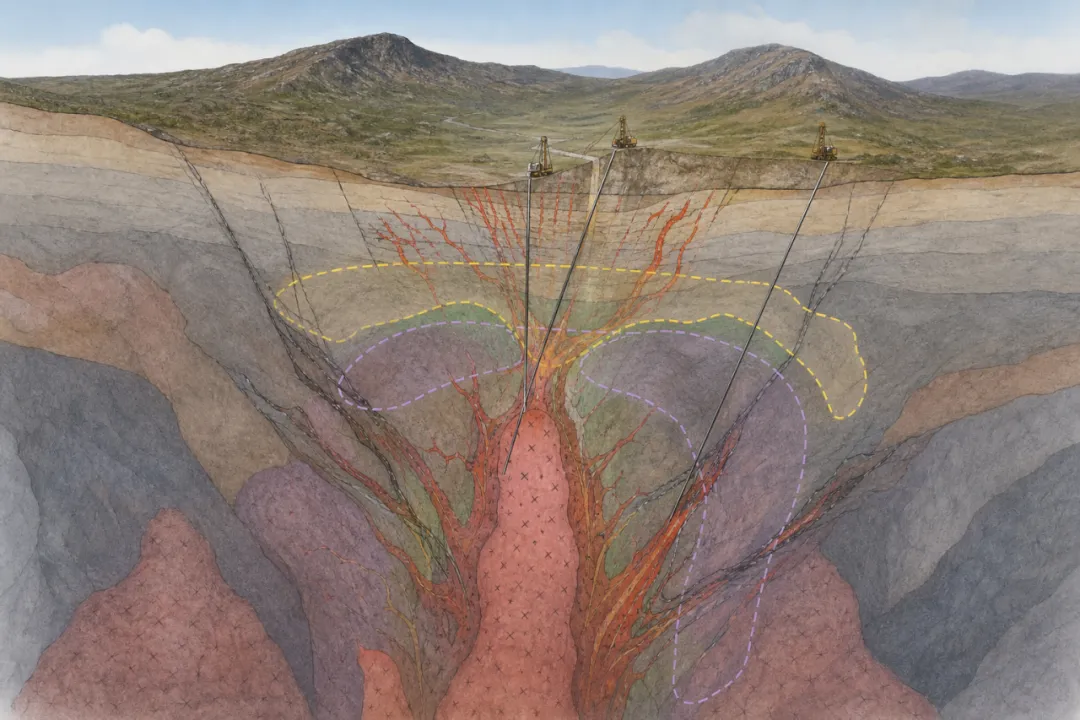
GAIA organizes geology, drilling, mineralogy, structure and technical information into a traceable evidence system. As new drilling, geophysics and field observations arrive, the interpretation must be updated and, when necessary, rejected. A deep target deserves capital only when it has a geological basis, traceable supporting data and an executable test.
This is also a boundary for exploration AI: an anomaly is not an orebody; a prediction is not a discovery; a target is not a resource. AI can improve the organization of complex information and the management of uncertainty so that scarce capital addresses the geological questions that actually control value.
From buying resources to buying validation rights
Once the stand-alone value of the shallow gold case was reassessed, the transaction logic had to change. Under the vendor narrative, investors were buying a defined low-grade, bulk-tonnage gold asset. Under the audit, the shallow resource could not support the initial US$45 million price. The remaining option value lay mainly in a deep porphyry-skarn hypothesis that had yet to be tested.
The transaction therefore shifted from purchasing confirmed resources to purchasing a geologically grounded right to validate. The source proposal replaced a direct acquisition with a staged earn-in. Phase one would invest US$4 million over 24 months in dedicated deep exploration and earn 51% of the joint venture after agreed work. Phase two would proceed only if deep drilling further supported Cu-Au mineralization, at which point additional investment and feasibility work could begin.
This structure matches mineral risk. Do not keep paying a premium for a shallow story whose economics fail. Use limited capital to test the deep hypothesis. If evidence is insufficient, control further exposure. Good technical due diligence is not merely a negotiation tool; it redesigns how risk is identified, tested and allocated.
Conclusion: returning AI to value judgment
The Ak case connects three inseparable questions: Is the resource real? Can the ore be developed economically? Does the deposit model explain the mineral system? A low cut-off can expand tonnes but cannot replace recovery and cost. A compliant resource model supplies a common reporting language but does not automatically prove continuity. A failed shallow case does not mean the entire licence lacks option value.
GAIA’s approach reconnects underlying data, mineral-system reasoning, engineering constraints and economics. For investors, this means earlier recognition of overstated resources and risks not worth purchasing. For operators, it means finding the next exploration direction more quickly after an old model fails.
From resource audit to deep-target interpretation and M&A decision support, the objective is consistent: help capital identify subsurface value more accurately—both the value that already exists and the next hypothesis that genuinely deserves verification.